

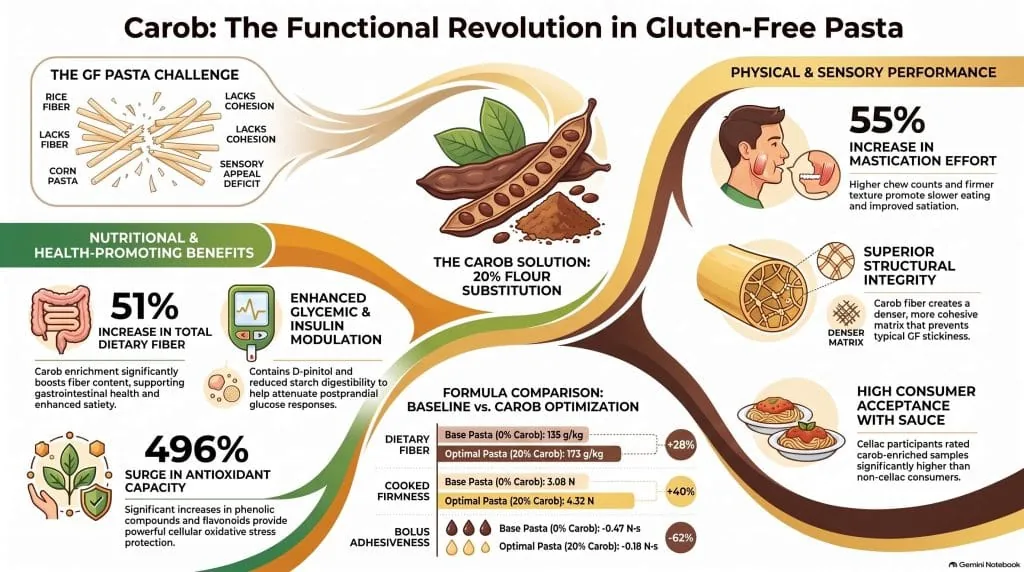
A post-cooking firmness that climbs from 3.08 N to 4.83 N, fibre up 51% and starch digestibility reduced by 28%: that is what incorporating carob flour into a chickpea-teff base delivers, according to a study published in 2026 in Frontiers in Nutrition. The historic flaw of gluten-free pasta — the missing gluten network that leaves it sticky and soft — finds a corrective here, straight from the Mediterranean basin.
Commercial gluten-free products rely mostly on refined rice and maize flours. Hence a pasty texture, excessive stickiness and a poor nutritional profile. Around 1% of the world’s population lives with coeliac disease, and nearly 6% of Europeans and Americans report non-coeliac gluten sensitivity. This market has long been looking for an ingredient able to close the technological gap and the nutritional gap in a single move. Gómez-Llorente’s team tested carob flour (Ceratonia siliqua L.) on both fronts. For specialist ingredient suppliers, the signal is direct.
Why does carob flour repair the texture of gluten-free pasta?
Carob contains structuring proteins — “carubin” — and fibres which, in the process tested, densify the protein-starch matrix. Cryo scanning electron microscopy (CryoFESEM) imaging shows a cohesive structure with almost no internal voids. In plain terms, carob fibre plays the binding role gluten no longer provides.
Instrumental measurements confirm it. Post-cooking firmness climbs from 3.08 N for the control formula to 4.32-4.83 N for the 20-30% substitutions (p < 0.05), with higher water absorption (WAI) and swelling (SI) indices. Chewing tests on five adults measured 56% more jaw strokes and lower bolus stickiness — the classic weak spot of gluten-free.
-
Post-cooking firmness: +40 to +57% vs control (F20-F30)
-
Bolus stickiness: significantly reduced during chewing
-
Internal matrix: dense and cohesive, with no structural voids
A real nutritional gain, but a trade-off to own
On the nutrition side, carob flour pulls the profile upward on several axes. Total dietary fibre increases by 51% (204 g/kg in F30 versus 135 g/kg in F0) and starch drops by 23%. In vitro starch digestibility falls 28% in F30 compared with the control — and sits 42% below traditional white bread, an argument for glycaemic modulation.
The picture has its counterpart. Proteins and lipids fall by around 20% and 37% respectively, while simple sugars jump by nearly 183%. This nutritional trade-off is settled at the formulation brief, not afterwards.
| Parameter (F30 vs F0) | Change |
|---|---|
| Total dietary fibre | +51% |
| Starch | −23% |
| Starch digestibility | −28% |
| Total polyphenols | +67% |
| DPPH (antioxidant) activity | +496% |
| Proteins | −20% |
| Simple sugars | +183% |
On the functional side, bioactive compounds progress with the dose: flavonoids +223%, condensed tannins +219%, D-pinitol at 36.2 mg/kg in F30. In an LPS-stimulated Caco-2:HT-29 intestinal co-culture model, suppression of interleukin-6 (IL-6, an inflammatory marker) moves from around 20% with the control to around 30% with F30. TNF-α suppression, however, does not change significantly.
Why the 20% formulation stands out as the reference
More carob is not always better. Sensory analysis, run on 70 non-coeliac and 20 coeliac consumers, points to the 20% substitution (F20) as the optimum: it improves acceptance compared with the carob-free control. Beyond that, the darker colour and stronger taste penalise appreciation. The 30% formula was in fact withdrawn from the second sensory session with the coeliac group.
Among coeliacs, the retained formulas score 5.8 to 6.3 out of 9 served plain, rising to 6.7-7.1 with a tomato sauce. In other words, the sauce masks carob’s colour and aromatic intensity — a usage indication worth keeping in mind for product positioning.
The specification point that becomes a sales argument
For an ingredient supplier, carob flour offers a rare double claim: technological (firmness, hold, reduced stickiness) and nutritional (fibre, antioxidants, lower starch digestibility). The study fixes the useful inclusion rate — 20% — beyond which sensory performance drops off. For a gluten-free R&D team, that turns a process variable into a sales argument: a documented inclusion rate, a matrix characterised under the microscope, a quantified bioactive profile. What remains is arbitrating the rise in simple sugars and the fall in proteins, which can constrain the final claim. The authors specify that the human component evaluated oral processing and sensory acceptance, not metabolic or anti-inflammatory effects in vivo — on that ground, marketing caution is required.
What this signal redistributes on the gluten-free market
Carob is a sustainable Mediterranean resource, rich in polyphenols. Its integration into a chickpea-teff base — two ingredients already established in gluten-free — requires no supply chain disruption. For nutrition players, carob flour positions itself as a dual-use functional ingredient, texture and nutrition, that addresses coeliacs and health-conscious consumers alike.
The main brake is sensory: dark colour and pronounced taste. The documented solution — pairing with a sauce — points towards prepared dishes rather than plain pasta. In vivo studies remain to be run to establish the bioavailability of the bioactive compounds, so any health argument must stick to the measured data. Carob flour does not replace a claim dossier; it provides its first building blocks.
References
-
Francisco de Souza, H. (2026). A Mediterranean ingredient gave gluten-free pasta an unexpected upgrade. News-Medical.
FAQ
What carob flour inclusion rate should be used in gluten-free pasta?
The Gómez-Llorente et al. study (2026, Frontiers in Nutrition) identifies 20% substitution as the optimum: the best balance between structural performance, reduced starch digestibility and sensory acceptance. Beyond that, the dark colour and intense taste penalise appreciation.
What technical gains does carob flour bring on texture?
Post-cooking firmness moves from 3.08 N (control) to 4.32-4.83 N for the 20-30% formulas, with a denser protein-starch matrix observed under CryoFESEM and reduced bolus stickiness during chewing. It is a direct corrective to gluten-free pasta’s stickiness flaw.
What is the nutritional trade-off to own?
Carob raises fibre by 51% and cuts starch by 23% (F30 vs F0), but lowers proteins by around 20% and lipids by 37%, while simple sugars jump by nearly 183%. This compromise must be integrated at the formulation brief and can constrain the final claim.
Does carob flour allow a glycaemic modulation claim?
In vitro starch digestibility falls 28% in F30 and sits 42% below white bread, suggesting glycaemic modulation potential. However, the authors specify that no in vivo study has measured a metabolic effect in humans — any health claim must remain cautious.
How to manage carob’s dark colour and pronounced taste?
The study shows that serving the pasta with a tomato sauce lifts coeliac acceptance scores from 5.8-6.3 to 6.7-7.1 out of 9, the sauce masking colour and aromatic intensity. That points positioning towards prepared dishes rather than plain pasta.
Does carob offer a supply sustainability advantage?
Carob (Ceratonia siliqua L.) is a Mediterranean resource presented as sustainable and rich in polyphenols. Combined with a chickpea-teff base already established in gluten-free, it imposes no supply chain disruption — an asset for ingredient suppliers.